| Product | Brand | Type | Key Benefit |
|---|---|---|---|
| Esjay Toddler Busy Board | Esjay | 8-page sensory board | Develops fine motor skills, portable |
| Joyreal Montessori Busy Board Wooden | Joyreal | Wooden sensory board | Life-skill practice, travel ready |
| iPlay, iLearn 10 in 1 Cube | iPlay, iLearn | Multi-panel cube | Rich sensory experiences, portable |
| Joyreal LED Light Up Busy Board | Joyreal | LED switch board | Fine motor and STEM-inspired play |
| ABERLLS Montessori Busy Board | ABERLLS | Wooden busy board | Life skills, durable materials |
The following article examines these popular sensory boards for babies and toddlers, highlighting how each option supports early development, improves fine motor skills, and promotes independent play during travel, car rides, or quiet times at home. Each section provides objective details drawn from product features to help caregivers compare materials, durability, and learning outcomes. The buying guide at the end offers practical considerations for selecting the right busy board for different ages and needs.
Esjay Busy Board: 8 Pages Of Active Learning

Esjay’s Busy Board for toddlers is designed with 8 activity pages meant to engage for extended periods. The board features varied difficulty levels (2-4) to challenge without overwhelming a growing learner. Activities include zipper, shoelace, belt, buttoning, clock, calendar, shape matching, threading, and alphabet/number themes. The design supports hand-eye coordination, cognitive recognition, and early spelling skills through hook-and-loop letters. While it delivers rich play, caregivers should supervise due to small parts. The soft fabrics reduce hard corner exposure and enhance travel portability.
Joyreal Montessori Wooden Busy Board

This Joyreal wooden busy board emphasizes Montessori-inspired play with 10 diverse activities and travel handles for on-the-go learning. Suited for car or plane travel, the board includes latches, gears, a fidget spinner, a music box, mirrors, and hidden surprises behind doors. The activities encourage dexterity and life-skill practice, including buttons, shoelaces, and Velcro. Made from sturdy wood, it’s designed to withstand active exploration, while rounded edges and secure parts minimize safety concerns for toddlers.
iPlay, iLearn 10 In 1 Busy Board Cube

The iPlay, iLearn cube offers 10 activity panels in a compact cube, featuring a spinner, whack-a-mole, steering wheel, rocket plug, key pairing, and more. Designed for ages 6 months and up, it aims to foster creativity and imagination while supporting fine motor skills and hand-eye coordination. The cube uses vibrant colors and varied textures to provide sensory stimulation. Safety-conscious design includes rounded edges and secure components suitable for travel use, making it a practical option for car and plane journeys.
Joyreal LED Light Up Busy Board

Joyreal’s LED Light Up Busy Board adds a visual dimension with 10 switches and 19 LED bulbs set on a wooden base. The lights align with switch operation to provide immediate feedback and engagement. This setup supports fine motor control, sensory exploration, and color recognition through interactive lighting. It’s portable enough for travel and quiet enough for airplane use, especially when batteries are included. The board emphasizes safe, non-noisy play suitable for shared spaces and early STEM exposure.
ABERLLS Montessori Busy Board
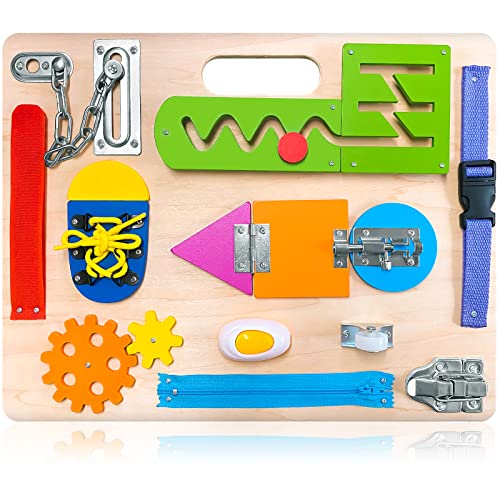
ABERLLS presents a wooden Montessori busy board designed to cultivate basic life skills. The board includes latches, Velcro, switches, gears, key locks, zippers, and buttons—each contributing to cognitive development and hand dexterity. Smooth wood, rounded edges, and secure construction emphasize safety while encouraging exploration. The activities mimic everyday items, helping children practice dressing, tying laces, and other routines in a structured, self-directed learning format. It’s a durable option suitable for ages 1-3 years and ideal for caregivers seeking traditional materials.
Buying Guide: Key Considerations For Choosing A Sensory Board
When selecting a sensory board for a baby or toddler, consider age range, safety, materials, and the learning goals you have in mind. Multi-activity boards with varied textures, colors, and mechanisms can support sensory processing, fine motor skills, and early problem solving, while simpler boards may be better for younger infants just exploring touch and cause-and-effect.
Durability and safety matter: look for boards with smooth finishes, rounded edges, securely attached components, and non-toxic materials. If you expect frequent travel, prioritize compact designs with handles or a lightweight frame and quiet operation to avoid noise disruption in public spaces.
Versatility is another factor: some boards emphasize life-skills like dressing, fastening, and zippering, which can be particularly beneficial for toddlers preparing for preschool routines. Others focus on STEM-inspired features such as LED lights or gears to spark curiosity and early cognitive concepts. Consider whether you want open-ended play or guided activities with specific learning outcomes.
Size and portability should align with your routine. A larger board may stay at home and offer more activities, while a smaller cube or travel-board version can fit a car seat, stroller, or diaper bag for on-the-go entertainment. Check battery requirements for LED boards and ensure batteries are age-appropriate and easily replaceable.
Accessibility and inclusivity are also important. Some boards are noted as suitable for children with autism or ADHD due to predictable mechanisms and repetitive tasks, while others may be more general. If a child has specific sensory needs, choose features that provide calming textures or predictable sequences to minimize overstimulation.
Price and maintenance are practical considerations. Wooden boards tend to be durable and longer-lasting, while fabric-heavy designs may require gentle cleaning. Consider how easy it is to clean small parts and whether replacements are available if a piece becomes loose.
In summary, the best sensory board for your child balances age-appropriate challenges, safety, portability, and the right mix of tactile and cognitive activities. Review the activities offered, the size and weight for travel needs, and the materials used to ensure durability and long-term use.