Parents seeking engaging, development-focused activity centers for babies will find a range of play tables that support fine motor skills, sensory exploration, and early learning. This article highlights five top-rated options, each designed to grow with a child from toddler to preschool years. Explore features, age suitability, and how each unit can fit into different play spaces. A quick summary table follows to help you compare essentials at a glance.
| Product | Brand | Key Benefit |
|---|---|---|
| VTech Magic Star Learning Table (Yellow) | VTech | Two-language activities, fine motor actions |
| Dahuniu Baby Toy Activity Center | Dahuniu | Multi-sensory lights, sounds, and instruments |
| LeapFrog Little Office Learning Center | LeapFrog | Imitative play with laptop, globe, and phonics |
| BACCOW Baby & Toddler Toys Activity Table | BACCOW | Sturdy design with musical and learning modes |
| HEYLANDU 7‑in‑1 Montessori Sensory Table | HEYLANDU | Multiple activities for fine motor and cognitive growth |
VTech Magic Star Learning Table (Yellow) Review
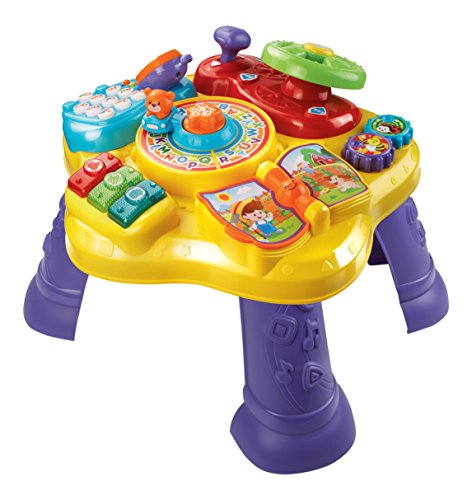
The VTech Magic Star Learning Table in yellow offers six bilingual activities in English and Spanish, encouraging exploration and learning. Children can turn a steering wheel to drive the bear around, flip a book page to hear nursery rhymes, and turn gears to strengthen fine motor skills. Light-up music buttons introduce colors and sounds, providing multi-sensory engagement. The table is compact for smaller spaces and designed to attract toddlers with familiar, playful icons. Suitable for early learners, this unit blends language exposure with hands-on discovery to support cognitive and motor development.
Dahuniu Baby Toy Activity Center Review

The Dahuniu activity center is designed for 6–18 month olds, featuring colorful lights, classic music, and multiple activities to spark exploration. It includes multi-instrumental activities, gear mechanisms, and interactive elements like pretend phone keys that help babies learn numbers, shapes, and colors while developing fine motor skills. The unit can be used with or without legs, allowing floor or table play, and offers two-level volume control to accommodate different environments and sensitivities. It emphasizes safe, sturdy construction for active babies and toddlers.
LeapFrog Little Office Learning Center Review
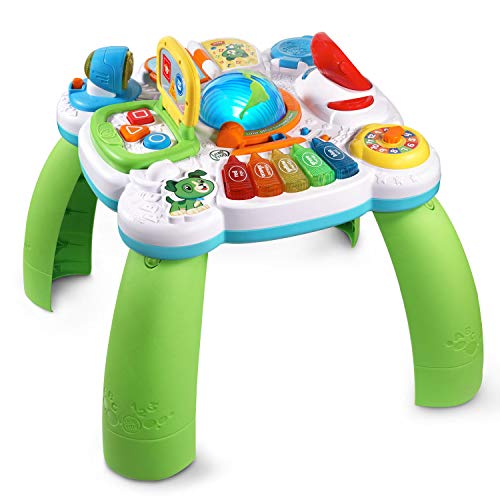
This desk-style learning center introduces early role-play with a laptop, phone, globe, and 27 electronic touch points. It features Explore, Learn, and Music modes to reveal first words, greetings, and world music, enabling imaginative play and social language development. Opening the laptop reveals learning shapes and animals through responsive buttons and screen visuals. The setup supports cognitive growth, vocabulary expansion, and pretend play, making it a strong option for toddlers beginning to simulate real-world tasks.
BACCOW Baby & Toddler Musical Activity Table Review

The BACCOW activity table emphasizes sturdy construction with thick, frosted legs for stable play. It offers multiple learning modes, including music and educational activities that cover numbers, shapes, colors, letters, and storytelling. The design allows for varied play experiences in a compact footprint, making it suitable for both floor and table play. Its versatility supports toddlers through early preschoolers, encouraging exploration, rhythm, and basic cognitive skills through interactive songs and activities.
HEYLANDU 7‑in‑1 Montessori Sensory Table Review

The HEYLANDU 7‑in‑1 Montessori sensory table combines seven activities in one, including a bead maze, shape matching, shape sorter, carrot harvest, fishing game, spinning gears, and an animal maze. Designed for ages 1–6, it uses non-toxic paint and smooth edges to ensure safety. The wooden construction supports durable, long-lasting play, while the variety of games promotes fine motor skills, cognitive growth, and creativity. This option suits households seeking a more traditional wooden play table with a broad skill set that scales with a child’s development.
Buying Guide: Key Purchase Considerations
When selecting a play table for a baby or toddler, consider safety, durability, and developmental fit. Look for sturdy bases, rounded edges, non-toxic finishes, and chew-safe components for younger children. Consider space: some models are compact for small rooms, while others offer taller designs that transition into early childhood use. Activities should balance sensory input, fine motor challenges, and pretend play to maximize engagement. Finally, assess adaptability: tables that offer multiple modes, adjustable volumes, and options to switch from floor to table play can provide longer-term value as your child grows.
Developmental perspectives include sensory stimulation, language exposure, and early math and problem-solving skills. Tables with bilingual options support multilingual exposure, while those with musical components encourage rhythm and auditory processing. Safety considerations include age recommendations, weight limits, and how components attach or detach for cleaning. For space-conscious households, modular or foldable designs can help keep play areas organized while still offering rich learning experiences.
In short, choose a play table that aligns with your child’s current interests and growth trajectory. A well-chosen unit can become a central, evolving hub for exploration, creativity, and early learning across the toddler years and beyond.