Parents and caregivers increasingly turn to high-contrast flash cards to support newborn visual development and early cognitive skills. This article reviews top-rated black-and-white flash cards designed for babies from birth to 12 months, highlighting how simple patterns, shapes, and color accents can engage a baby’s right-brain activity and support learning through eye-tracking, memory, and tummy-time play. Use this guide to compare options, features, and how each set aligns with different developmental stages.
Summary of Selected Products
| Product | Brand | Key Benefit |
|---|---|---|
| beiens High Contrast Baby Flashcards (0-3 Months) | beiens | Right-brain activation, fast-paced visual stimulation |
| The Original High Contrast Montessori Flashcards (Montessori) | Genius Baby Toys | Set of reversible black/white/red cards with a stroller clip |
| beiens 80 Pcs High-Contrast Flashcards | beiens | Multiple age ranges, 80 cards, 160 pages with varied themes |
| Kopokita High Contrast Baby Cards (0-3 Months) | Kopokita | Black-and-white with red accents, rounded-corner safety |
| Merka Newborn Sensory Flash Cards | merka | 50-pack set, black & white visuals for early stimulation |
Beiens High Contrast Flashcards For Newborns

These flashcards target early brain development by promoting rapid visual stimulation. The set emphasizes right-brain activity, which is believed to support quick pattern recognition and initial memory formation. It includes cards designed across age ranges from 0 to 36 months, making it useful as a baby grows. The materials focus on safe, simple visuals that are easy for little eyes to track during short, frequent viewing sessions.
The features emphasize quick visual changes to engage the right hemisphere and help cultivate instantaneous memory. This can complement daily routines by providing brief, high-contrast interactions. The design aims to be a practical starting point for parents seeking structured visual stimulation during the newborn stage and early infancy.
The Original High Contrast Montessori Flashcards

This set is presented as a classic Montessori approach, featuring six reversible cards in black, white, and red. The cards are printed on durable laminated stock and designed for flexibility—parents can clip them to strollers or car seats to create on-the-go visual play. Each card measures about 4.8 inches per side, striking a balance between visibility for small eyes and ease of handling by tiny hands. The included red clip and reusable pouch add to convenience and portability.
Educationally, the cards support early visual discrimination and introduce contrast-rich images. The durable construction helps withstand frequent handling during tummy time, travel, and quiet play. While simplicity is key for newborns, the red accents provide an additional color cue that can become a stepping stone toward more complex visual processing as babies grow older.
Beiens 80 Pcs High-Contrast Flashcards
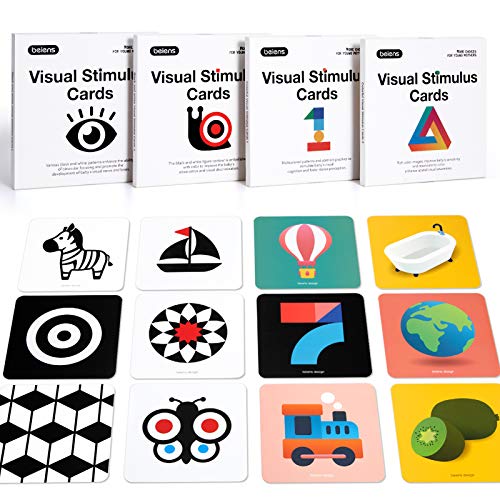
This larger set expands on the 0-3 month and 3-6 month range with 80 flashcards and 160 pages of content. The design maintains a focus on high-contrast black and white visuals and incorporates varied themes such as shapes and geometric figures to broaden early exposure to different visual stimuli. The kit is marketed to support instantaneous memory development through rapid visual changes between cards, aligning with right-brain activation principles.
With multiple age-appropriate themes, caregivers can tailor sessions to a baby’s current developmental stage. The product emphasizes durable construction and clear, vivid contrasts to help babies focus during short interactions. The range of topics is designed to evolve with the infant’s growing perceptual abilities, aiding gradual progression from simple patterns to more complex visuals.
Kopokita High Contrast Baby Cards (0-3 Months)

Designed for newborns through early infancy, these cards emphasize rounded-corner safety and easy handling for tiny hands. The set includes black-and-white patterns with red accents to grab attention and support visual tracking. The cards are described as durable and kid-friendly, with anti-glare finishes and high-contrast imagery to assist eye focus during short play sessions. The product positioning highlights safe materials and a kid-friendly size of approximately 5.7 by 5.7 inches.
The emphasis on safety and usability makes this an appealing option for caregivers prioritizing tactile experience alongside visual stimulation. The inclusion of a safe, rounded design helps reduce concerns about sharp edges while babies explore with their hands and mouths. As infants develop, the combination of black-and-white visuals and color highlights can support progression to more complex stimuli.
Topsochir Black and White Flash Cards With Mirror
The Topsochir set combines high-contrast black-and-white patterns with a baby-safe mirror. The mirror fosters facial recognition and social development as babies observe themselves while examining the cards. The collection targets a range from 0 to 6 months, with a tummy-time focus that aids in motor development while keeping visual attention engaged. The product highlights action-oriented play to reduce fussing during diaper changes and other routines.
Features emphasize variety—black-and-white patterns, a built-in mirror, and stability across tummy time and play sessions. Parents can rotate through different cards to maintain interest and encourage exploring new shapes, textures, and faces. This approach supports a well-rounded early learning experience by combining sensory input with motor engagement.
High Contrast Bright Cards For 0-12 Months

This 96-piece set is designed for three developmental stages: 0-3 months (black and white with high contrast), 3-6 months (black and white with basic colors), and 6-12 months (abstract shapes with color). The goal is to support visual attention, memory, and early cognitive association as babies mature. The cards are printed with eco-friendly vegetable-based inks and are designed to withstand frequent handling during tummy time and play sessions. A tiered progression helps caregivers introduce increasingly complex stimuli as infants grow.
Across these cards, the emphasis remains on safe materials and clear visuals. The design anticipates the evolving needs of infants—from simple high-contrast patterns to more colorful and abstract shapes—facilitating a structured developmental path. This approach can aid in building recognition and early language basics as babies begin to associate objects with sounds and words.
Buying Guide: Key Considerations For Choosing Baby Flash Cards
- Developmental stage alignment: Look for sets that provide a progression from newborn to older infant stages, with targeted contrasts and color doses appropriate for each age group.
- Visual clarity and contrast: High-contrast black-and-white designs with occasional color accents tend to be most engaging for early development, supporting tracking and recognition.
- Safety and materials: Prioritize non-toxic inks, rounded corners, and durable materials that withstand mouthing and frequent handling during tummy time.
- Size and handling: Cards around 5.5 to 6 inches square are generally easy for small hands to grasp and for caregivers to present during play sessions.
- Portability and storage: Sets with clips, pouches, or pouches for carriages make it simpler to bring learning cards on the go and keep sessions consistent.
- Versatility: Consider whether a kit includes mirrors, shapes, animals, or abstract patterns, offering broader sensory experiences beyond mere patterns.
- Cleanability: Materials that wipe clean and resist staining are practical for busy households with babies who explore with fingers and mouths.
- Language pairing: Some sets include descriptive cues or simple labels that can later support vocabulary development as language emerges.
- Durability and longevity: A multi-stage set that remains usable across several months minimizes the need for frequent replacements while babies develop.
- Budget and value: Compare card counts, features, and extras (clips, pouches, mirrors) to assess overall value relative to the baby’s developmental trajectory.
When selecting flash cards for a baby, parents should assess how the set aligns with routine activities—naptime, tummy time, stroller walks, and quiet play. A well-chosen mix can provide consistent, age-appropriate stimulation without overwhelming the infant. Remember to supervise interactions and rotate cards to maintain interest while ensuring safety at all times.