Parents seeking screen-free, hands-on learning toys for babies around 6 months and older can consider busy boards that promote fine motor skills, sensory exploration, and early problem-solving. The following selections emphasize durable materials, safe design, and portability for travel. Each option offers a variety of activities that engage little hands while supporting developmental milestones. Below is a quick overview to help families compare features and choose the best fit for their child’s age and interests.
| Product | Brand | Key Benefit | Age Range |
|---|---|---|---|
| iPlay, iLearn 10 in 1 Busy Board Cube | iPlay, iLearn | 10 activity panels for diverse play | 6–18+ months |
| ELLECK 6-12 Months Busy Cube Teether | ELLECK | 6 activity panels with textured surfaces | 6–18 months |
| Zsinb Montessori Busy Board | Zsinb | 10 activity panels with varied stimuli | 6–18 months |
| Montessori Busy Board for Toddlers 1-3 | COO & CRADLE | Realistic daily-life switches and appliances | 1–3 years |
| Potatomato Wooden Busy Board | Potatomato | 12-in-1 activity center with foldable stand | 6–24 months |
iPlay, iLearn 10 In 1 Busy Board Cube

- 10 activity panels offering varied experiences to foster creativity and independent play.
- Includes interactive elements like spinner, whack-a-mole, steering wheel, Rocket Plug, Key Pairing, and more.
- Vibrant colors, textures, and sounds provide sensory stimulation and help develop fine motor skills.
- Durable construction with rounded edges and safe materials for baby use.
- Designed for travel and everyday use, suitable for 6–18 months.
ELLECK Baby Toys 6-12 Months Busy Cube Teether
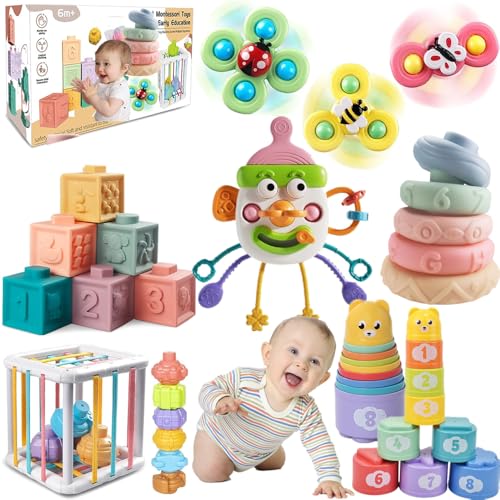
- Contains building blocks, stacking cups, suction spinner, and 6 activity panels for varied play.
- Supports color and shape recognition, motor development, and hand-eye coordination.
- Made from premium materials; safety features include BPA-free components and rounded edges.
- Great for babies 6–12 months as a multisensory learning toy.
Zsinb Montessori Busy Board & Activity Cube

- 10 in 1 Montessori-style panels including spinner, whack-a-mole, steering wheel, and Rocket Plug.
- Vivid colors and diverse textures support sensory development and fine motor skills.
- Durable construction with safety-minded design suitable for 6–18 months and beyond.
- Compact yet engaging for travel, car rides, and plane trips.
Montessori Busy Board for Toddlers 1-3

- All-in-one Montessori setup for ages 1–3, emphasizing hands-on exploration and sensorial play.
- Includes daily-life-inspired features like a switch board, refrigerator door, washing machine, and music button.
- Helps develop cognitive and manipulative skills through realistic play scenarios.
- Suitable for younger children around 6–12 months when guided, then grows with the child.
Potatomato Montessori Wooden Busy Board

- 12-in-1 activity center with foldable stand for versatile play modes at home or on the go.
- Montessori-inspired design promotes hand-eye coordination, problem solving, and cognitive growth.
- Natural pine wood, non-toxic materials, smooth edges for safe exploration.
- Ideal as a screen-free travel toy or birthday gift for babies 6–24 months.
Buying Guide: Busy Boards For Babies And Toddlers
Key considerations include age appropriateness, safety, material quality, and versatility. For younger babies around 6 months, ensure the board has large, easy-to-grab elements and rounded edges. For toddlers, look for more varied panels that introduce cause-and-effect, problem solving, and fine motor challenges.
Material and safety: Opt for BPA-free plastics or natural wood with non-toxic finishes. Inspect for loose parts, sharp edges, or small pieces that could be choking hazards. Durable builds help withstand curious hands and travel wear.
Activity variety: A strong busy board combines sensory elements (textures, colors, sounds), fine motor tasks (pins, gears, switches), and simple cognitive challenges (patterns, sequencing). Look for a balanced mix across panels rather than a single type of activity.
Portability and setup: Lightweight designs with handles or foldable stands are ideal for car trips, flights, or train rides. Some boards can convert into tabletop setups, which adds flexibility in different environments.
Age range and growth: Boards labeled 6–12 months should still be engaging as a child approaches 2 years. Consider boards that evolve with the child’s skills or include features that scale in difficulty.
Price versus value: Higher-quality materials and larger panel sets may cost more but can offer longer usability. Compare the number of activities, safety features, and warranty when evaluating value.
Travel suitability: For travel, prioritize compact dimensions, sturdy mounting options, and minimal loose parts. A board with a foldable stand or carrying handle tends to be more travel-friendly.