Answer: A learn-to-sit baby seat is ideal for parents seeking a safe, supportive place for babies to practice sitting up while entertaining them with toys. These seats are best for babies who can hold their head up with some head and neck control, typically around 4 to 12 months. The top picks below are chosen for portability, adjustability, washable fabrics, and stimulating toys that support early development. The table below highlights five recommended options to compare at a glance.
| Product | Why It Stands Out |
|---|---|
| Fisher-Price Rainbow Sit-Me-Up | Classic, portable with a wide base and machine-washable seat pad |
| Fisher-Price Pacific Pebble Sit-Me-Up | Compact and portable with engaging linkable toys |
| Bright Starts Purple Paradise Learn-to-Sit | Two-position, grow-with-baby design with removable seat pad |
| Bright Starts Wild Wiggles Learn-to-Sit | Similar grow-with-baby concept with comfy padding |
| Baby Einstein Kickin’ Tunes | Music and language play modes that support early learning |
Fisher-Price Rainbow Sit-Me-Up Floor Seat

This portable infant chair supports upright sitting with a sturdy, wide base and cushy seat. The design is ideal for transitional playtime and quick trips. It’s best for parents who want a washable, travel-friendly option that doubles as a comfy spot for supervised sitting practice. The seat folds compactly, aiding storage in small spaces or during travel. A caution: the seat’s use should be supervised to ensure a stable surface and prevent tipping on soft or uneven floors.
Fisher-Price Pacific Pebble Sit-Me-Up Floor Seat
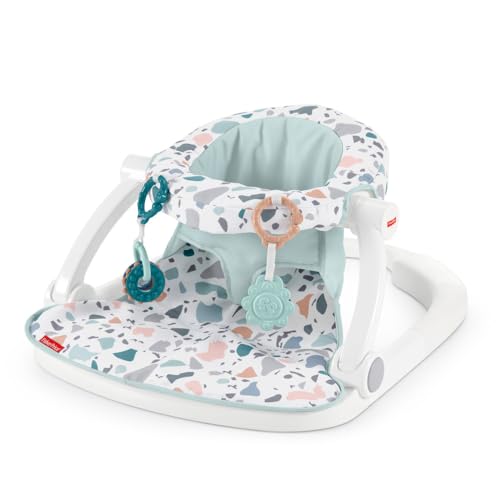
Best for parents who want a lightweight, portable option with engaging toys. It supports a baby in an upright position with a wide base and includes two linkable toys to hold a baby’s attention. It’s a compact choice for travel or small homes. Limitation: toy variety is fixed; newer babies may need additional activities for longer play sessions.
Bright Starts Purple Paradise Learn-to-Sit

Best for growing with baby. This two-position design allows earlier use in the lower position when the baby can support their head and later use in the upright position for sitting and playing. It offers plenty of leg room, a padded seat, and a high back for support. The seat pad is removable and machine washable. Choose this if you value a longer-term seat that adapts to progress; avoid if you need a quick, single-position option.
Bright Starts Wild Wiggles Learn-to-Sit

Best for babies who benefit from a similar two-position, grow-with-me approach. It mirrors the Purple Paradise design with ample leg room and a supportive back. The seat pad is removable and machine washable for easy cleaning. Choose this if you want a slightly more playful pattern while keeping the same functional design; caution: ensure the tray or toys stay within reach to prevent over-reliance on toys for support.
Baby Einstein Kickin’ Tunes Learn-to-Sit

This seat combines sit-up practice with music and language play, featuring multiple modes to grow with the child. It offers two positions and a detachable kick piano that can be used on a tray or off the chair for on-the-go play. It’s best for infants who respond well to auditory stimulation. A limitation: the piano may take up space on a dining tray, so plan for a larger surface area during mealtime use.
Buying Guide
- What age range should I use a learn-to-sit seat? Most seats suit babies roughly 4 to 12 months, when head control starts to improve and sitting support is needed.
- What features matter most? Look for a wide, sturdy base, cushioned back and seat, removable and machine-washable fabrics, and toys or trays that stimulate development without being distracting.
- Portability or fixed setup? If you travel or have limited space, prioritize compact folds, light weight, and easy cleaning. If you’ll use it mainly at home, a larger, more stable model with richer toy options can be beneficial.
- Safety considerations? Ensure there’s no chair tipping on uneven floors. Always supervise and never leave a baby unattended in any seat, and avoid seats with sharp edges or choking hazards from small detachable parts.
- Maintenance and cleaning? Removable seat pads that are machine washable simplify cleaning after spills and drool, which are common at this stage.
Frequently Asked Questions
- Are learn-to-sit seats safe for newborns? These seats are typically designed for babies who can hold their heads up with partial support, not newborns. Always follow the manufacturer’s age guidance and supervise closely.
- Can a seat replace floor time? No. These seats are aids to practice sitting; babies also need tummy time and unstructured play on the floor for development.
- How do I clean the seat pad? Most pads are machine washable on gentle cycles. Remove the pad as directed and air dry or tumble dry on low heat based on care labels.
- Which seat is best for travel? The most portable options fold compactly and have lightweight frames, like the Rainbow Sit-Me-Up or Pacific Pebble variants.
- What should I look for in toy attachments? Toys should be securely attached, age-appropriate, and stimulate reaching, grasping, and visual tracking without posing a choking risk.