If you’re searching for high-contrast baby cards to support early visual development, these options are among the best for newborns to toddlers. Each selection focuses on black-and-white patterns and age-appropriate motifs to stimulate the optic nerve and strengthen memory. Best for busy caregivers who want simple, safe, and effective learning tools for infants and toddlers.
| Product | Best For | Age Range | Format | |
|---|---|---|---|---|
| Beiens High Contrast Flashcards (40 pages, 0-3 to 36 months) | Right-brain stimulation and memory building | 0-36 months | Cards | Rapid visual bursts to engage right-brain activity and memory |
| Kopokita High Contrast Cards (40 Pages, 0-3 months) | Safe, easy-to-handle starter set | 0-3 months | Cards | Double-sided, anti-glare design for eye protection |
| URMYWO Black and White Baby Toy (Tummy time book, 0-12 months) | Tummy time and sensory exploration | 0-12 months | Soft book | Includes patterns, mirror, and textures for multisensory play |
| Beiens 80 Pcs High Contrast Cards (160 pages, 0-36 months) | Comprehensive development across ages | 0-36 months | Cards | Multiple themes aligned to visual development stages |
| High Contrast Baby Flashcards (96 Pcs, 0-12 months) | Structured progression across early months | 0-12 months | Cards | Three age-based sets for gradual color and pattern exposure |
Beiens High Contrast Flashcards, 40 Pages

Features include rapid visual flash by design, aiming to activate the right brain and strengthen instantaneous memory. Best for caregivers seeking a structured set that grows with the child from 0 to 36 months. The cards are developed with educational input and grouped by age characteristics.
Best for: Parents focusing on early right-brain development and quick memory recall. Limitation: Information emphasizes development goals but does not document independent testing results.
Kopokita High Contrast Cards, 40 Pages

Designed for newborns up to 3 months, these cards use double-sided film with anti-glare treatment and high-quality ink for clear contrasts. The 5.7” x 5.7” size is easy for little hands to grasp. Rounded corners and smooth edges enhance safety during exploration.
Best for: New parents who want a safe, eye-friendly option with durable construction. Limitation: The set focuses on early months and expands less with older infants.
URMYWO Black and White Baby Toy

This tummy-time focused toy combines high-contrast visuals with a baby-safe mirror and soft materials. It supports visual development during the first six months and adds tactile and self-recognition experiences. Crinkle textures encourage exploration and auditory engagement.
Best for: Babies who benefit from multisensory stimulation during tummy time. Limitation: Weighs more towards a soft-book style experience than a standalone card set.
Beiens 80 Pcs High Contrast Cards
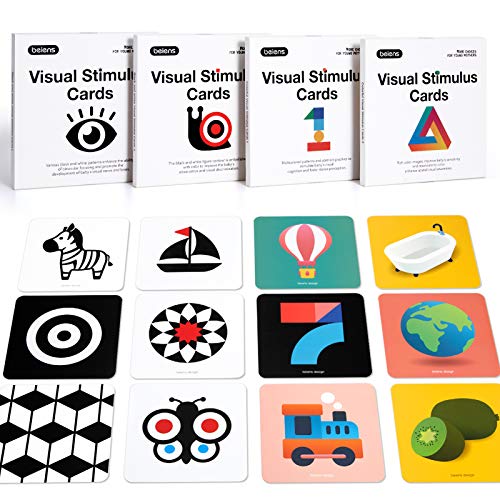
This larger set provides 80 flashcards across a 160-page layout with themes such as shapes and geometric figures. It emphasizes right-brain activation and rapid visual processing. The design enables caregivers to tailor daily routines around specific developmental milestones.
Best for: Families wanting broader variety and longer-term engagement across multiple months. Limitation: Some users may prefer a more compact starter set for very young infants.
High Contrast Baby Flashcards, 96 Pcs

Structured into three age-based sets (0-3M, 3-6M, 6-12M), this kit uses black-and-white patterns, then introduces color and shapes to extend learning. It aims to stimulate the right brain while supporting growing memory and attention spans. Cards are printed with eco-friendly ink and designed for durable use.
Best for: Caregivers seeking a gradual, age-graded progression. Limitation: Some sets may require more guided use to optimize outcomes for individual children.
Buying Guide: Key Considerations For Choosing High Contrast Cards
What is the primary goal? If the aim is faster right-brain activation and memory building, look for sets that explicitly mention rapid visual flashing and age-graded development. Consider the child’s age and whether you want a starter set or a long-term progression.
Age and progression
Choose cards that match your child’s current age and offer a clear path to older ages. Sets that provide multiple stages (0-3 months, 3-6 months, etc.) help caregivers adapt activities as vision and attention develop.
Safety and materials
Opt for non-toxic materials, rounded corners, and anti-glare finishes. Card sizes around 5.5” to 5.7” are easy for little hands to hold, while matte or anti-glare coatings reduce eye strain during short sessions.
Durability and ease of use
Durable cardboard or card stock with protective coatings is ideal for gnawing and handling by infants. Double-sided designs and clear imaging improve longevity and reduce wear with daily interactions.
Format preferences
Card decks offer quick daily sessions and simple rotation, while a soft tummy-time book can combine card-like visuals with tactile and mirrored elements for multisensory play.
Safety limits and guidance
Always supervise infants during visual activities. Start with short, frequent sessions (a few minutes at a time) and gradually increase as the child shows interest and attention.
FAQ: Quick Answers For Buyers
Q: At what age should I start using high-contrast cards? A: Many parents begin around birth to 3 months, when visual attention is developing; gradually introduce color and patterns as the baby grows.
Q: Do these cards require any setup? A: Most sets are ready to use straight out of the box; some include age-graded sections for progressive use.
Q: Are high-contrast cards safe for chewing? A: Reputable sets use non-toxic materials; always supervise to ensure safe handling.
Q: Should I choose a card deck or a tummy-time book? A: Card decks are compact and rotation-friendly; tummy-time books add multisensory elements like mirrors and textures.
Q: How do I measure effectiveness? A: Look for improvements in visual tracking, attention span, and early signs of memory recall over weeks of consistent use.