Whether you’re a traveling parent, commuting parent, or simply planning out-of-home feedings, a portable bottle warmer can speed up soothing hungry babies. This guide presents five top travel-friendly warmers, highlighting who they’re best for, how they heat, and practical limitations. Ideal for busy families, frequent travelers, and parents seeking compact solutions for parks, cars, or flights. The following brief summary table helps you compare key points at a glance.
| Product | Best For | Capacity | Heating Speed |
|---|---|---|---|
| Momcozy Portable Bottle Warmer (Purple) | Daily out-of-home feedings | 17 oz | 2–5 minutes |
| YKV Portable Bottle Warmer | Families needing dual modes | 17 oz | 3–5 minutes |
| Ninebee Portable Bottle Warmer | Twins or multiple daily feeds | 17 oz | 2 minutes |
| Tommee Tippee Travel Warmer | Very compact, no power needed | Thermal flask | |
| QIBOX Portable Warmer | Long battery life on the go | 17 oz | ~3–4 minutes |
Momcozy Portable Bottle Warmer – Dual Heating

This product uses dual heating modes to warm breast milk or water. It heats water to 104°F in about 2 minutes and breast milk to 98°F in roughly 5 minutes, offering precise temperature control for nourishment. It’s designed for on-the-go parents who want fast readiness and nutrient preservation for breast milk.
- Best for: Parents who prioritize quick on-the-go warming and keeping breast milk nutrients intact.
- Why selected: Combines fast heating with precise temperature options and a large capacity.
- Caution: Real-world heating times vary with starting temperatures and bottle material.
YKV Portable Bottle Warmer – Dual Modes
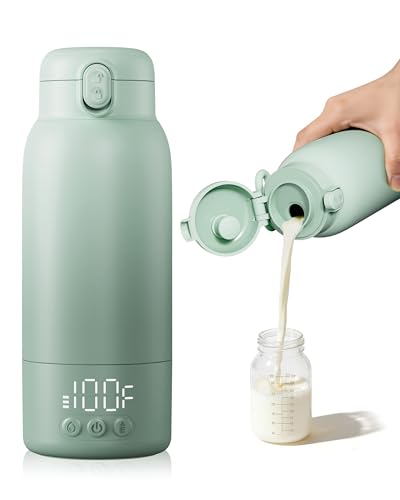
This warmer offers two modes: “Milk” and “Water,” with dual-temperature settings to heat breast milk to 98°F in about 5 minutes or heat water to 104°F in about 3 minutes. It features four water temperatures and three milk temperatures for precise warmth and nutrient preservation.
- Best for: Families needing flexible dual-mode warming for both milk and formula.
- Why selected: Clear, reliable temperature ranges support nutrient preservation and formula preparation.
- Caution: Heats faster with adequate power; ensure settings are correct to avoid over-warming.
Ninebee Portable Bottle Warmer – Large Capacity

This model emphasizes a 17-ounce capacity and a keep-warm function for extended feeding needs. It heats breast milk and water quickly and maintains the desired temperature for easy, multiple feeds during outings.
- Best for: Parents who want fewer refills during longer outings or twins needing multiple feeds.
- Why selected: High capacity with keep-warm capability reduces frequent re-heating.
- Caution: Heavier weight when fully loaded; consider bag space for travel.
Tommee Tippee Portable Travel Warmer

Tommee Tippee’s warmer uses thermal insulation to keep hot water ready for warming bottles or food while on the move. Its leak-proof and compact design makes it a simple option for travelers who want a dependable, non-electric solution in certain situations.
- Best for: Travel scenarios where carrying a powered warmer isn’t convenient.
- Why selected: No external heating source needed; compact and leak-proof.
- Caution: Requires pre-filled hot water; warming times depend on starting temperature and bottle size.
Momcozy Purple Portable Warmer – Dual Modes

This purple variant mirrors the dual heating approach for breast milk and water, offering precise temperature controls and a generous carrying capacity. It emphasizes fast heating and nutrient preservation, suitable for daily use outside the home.
- Best for: Parents who want a consistent dual-mode warmer with a compact form factor.
- Why selected: Similar feature set to other Momcozy models, including nutrient-preserving heating.
- Caution: Color differences may influence consumer preferences; ensure compatibility with your bottle.
Buying Guide: Key Considerations For Travel Bottle Warmers
What should you look for when choosing a travel bottle warmer? Consider capacity, heating speed, and how it’s powered. A larger capacity reduces refills, while faster heating helps when babies are hungry. Look for dual heating modes if you feed both milk and formula, and check whether the unit relies on USB, car adapters, or built-in batteries for portability.
- Power source: Choose a model with a portfolio of power options (USB-C, car charger, or built-in battery) to match your travel style.
- Temperature control: Precise settings (milk vs. water) help preserve nutrients and ensure safe temperatures for feeding.
- Capacity and keep-warm: Higher capacity is convenient for families with multiple daily feeds; a keep-warm feature reduces reheating needs.
- Portability: Weight, size, and bag compatibility matter for purses, backpacks, or diaper bags.
- Materials and safety: Food-grade materials and BPA-free design are important for baby health.
Practical Tips For Using A Travel Bottle Warmer
- Test temperatures with a bedside thermometer before feeding to prevent burns.
- Pre-fill water if required by the device, and keep spare bottles handy for quick changes.
- Carry a small insulated bag to maintain warmth between stops on longer trips.
FAQ
- Do travel bottle warmers require a power source? Many models offer built-in batteries, USB charging, or car adapters for flexible use.
- Which warmer is best for two children? Models with 17-ounce capacity and a keep-warm function are advantageous for multiple feeds in a day.
- Can these warmers preserve nutrients in breast milk? Dual-mode heat settings and precise temperatures help minimize nutrient loss during warming.
- Is a travel bottle warmer suitable for formula? Yes, many devices support both breast milk and formula heating with appropriate temperatures.
- What should I test before feeding? Always verify the final milk temperature and ensure the device’s water level complies with safety guidelines.
- Are these devices safe for baby use? Look for BPA-free materials and food-grade components to minimize contamination risk.