Parents seeking engaging, development-focused activity centers for babies around four months old can choose from several well-designed options. The right center supports motor skills, sensory exploration, and audience-appropriate play as babies begin to sit up and reach. Below, five carefully selected activity centers are highlighted, each with features that align with early developmental milestones. This guide emphasizes safety, growth potential, and value across a range of brands popular in American households.
Choosing the right activity center depends on your baby’s current abilities and your family’s needs. Some centers convert from floor play to cruise-and-play configurations, while others transition into snack or booster seating as your child grows. The following table summarizes the key details for the five featured products to help you compare quickly before exploring deeper in the sections that follow.
| Product | Brand | Key Benefit | Growth Stages |
|---|---|---|---|
| Skip Hop Explore & More Activity Center | Skip Hop | Three-stage growth with 25+ developmental activities | 4 months to 25 lbs, then toddler play table |
| Skip Hop Silver Lining Cloud Activity Center | Skip Hop | Classic three-stage design with a musical piano and cute designs | 4 months to 25 lbs, then play table |
| Fisher-Price Palm Paradise Jumperoo | Fisher-Price | 360-degree play with lights, music, and animal-themed toys | Typically 4 to 12 months and beyond as a jumper |
| Infantino 3-in-1 Discovery Seat & Booster | Infantino | Growing use from floor play to dining table booster | 4 months to 4 years |
| Bright Starts Deluxe SuperSeat | Bright Starts | Three-stage seating with 360° rotating tray | 4 months to 4 years |
Skip Hop Explore & More Activity Center
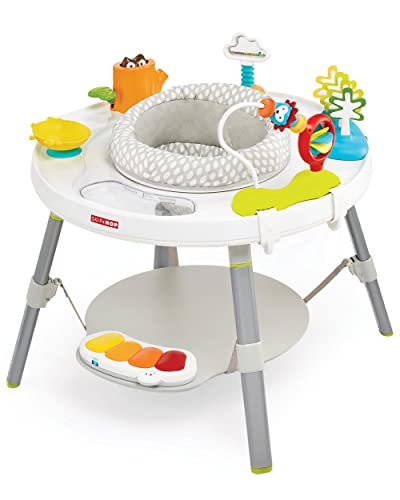
The Skip Hop Explore & More Activity Center is designed to grow with a baby from early sitting through toddler years. In its first stage, babies can sit, swivel, bounce, and play with a piano, owl peek-a-boo, and clip-on toys that adapt to a baby’s abilities. The center supports up to 25 pounds, providing long-lasting use as your child develops. Its Stage 2 transition allows cruising and interactive exploration, while Stage 3 converts into a play table for a new set of activities. The combination of music, light, and motion encourages sensory development and coordination. The modular design helps parents position toys for optimal reach and engagement.
Key features include a musical, light-up piano with three modes (piano, song, motion sensor) and a peek-a-boo owl that pops out and hoots. Positioning clips allow caregivers to customize toy placement as curiosity grows. The product emphasizes durability and ease of cleaning, which matters for daily use. For families prioritizing a long-term, growth-focused center, this Skip Hop model provides a structured progression from sit-and-play to a self-contained activity table.
Skip Hop Silver Lining Cloud Activity Center
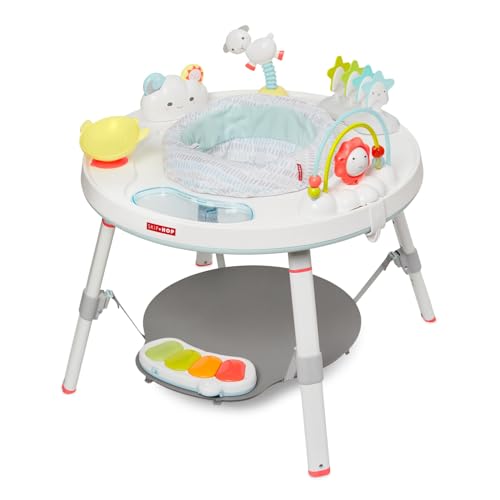
The Silver Lining Cloud version from Skip Hop offers a familiar three-stage growth path with engaging elements designed to entertain and educate. In early use, babies can enjoy the musical, light-up piano and the gentle movement of the clouds that pop up and squeak. The design is compact and portable enough for smaller living spaces, with the same 25+ developmental activities that encourage sensory exploration and fine motor skill development. As your child grows, the center shifts to cruising and interactive play, and finally converts into a toddler-friendly play table for continued use. The cloud motif adds a friendly, calming aesthetic for daily play sessions.
Parents should note the importance of supervising a 4-month-old during floor play and early stages to ensure safe engagement with the toys. The cloud theme, while adorable, also provides visual interest that can help with focus and tracking as babies reach for different components. The center is built to support steady growth without needing frequent replacements, making it a solid choice for families who want a single, enduring activity hub.
Fisher-Price Palm Paradise Jumperoo

Fisher-Price’s Palm Paradise Jumperoo is an enticing, exotic-themed activity center that emphasizes kinetic play through a 360-degree jumping experience. The seat rotates for access to multiple toy stations, encouraging babies to reach and bat at overhead toys. Features include various bat-at activities such as a sloth, butterfly spinner, flamingo roller ball, and a music-and-lights toucan. A portable Take-along toy piano toucan provides up to 20 minutes of music and lights that can be removed for travel. While primarily a jumper, the design supports early gross motor development and coordination, which complements floor play and other centers in this guide.
Caregivers should supervise using a Jumperoo for safe bouncing and avoid prolonged use in a single session to maintain balance and avoid overstimulation. The activity setup helps with leg strength, leg movement, and visual tracking, offering a dynamic alternative to stationary activity centers. This option is well-suited for families emphasizing interactive motion and musical engagement during the 4–12 month window.
Infantino 3-in-1 Discovery Seat & Booster

The Infantino 3-in-1 Discovery Seat & Booster offers a transformative design that grows with a baby from floor play to dining table use. It supports 4 months to 4 years (up to 33 pounds), maximizing long-term value. A built-in, light-up piano provides musical entertainment, and toy pods foster motor skill development with engaging visuals. The snack tray, hidden beneath the toys, makes transitions to feeding simple, reducing the need to move the baby mid-play. This flexibility is ideal for families seeking a single product that transitions from activity center to booster seat for meals and social interactions.
As a multi-use solution, Discovery Seat emphasizes versatility and practical design. It can function as a floor toy center to explore textures, sounds, and cause-and-effect interactions, then evolve into a dining companion. The design also supports quiet play to complement other activity centers, giving caregivers the option to rotate use across different rooms or routines. This makes it a practical choice for busy households that still want developmental richness in playtime.
Bright Starts Deluxe SuperSeat

The Bright Starts Deluxe SuperSeat is a three-stage seating system designed for babies from four months through early childhood. Stage 1 provides a soft foam-supported seat for upright positioning, Stage 2 offers an activity seat with a 360° rotating tray to keep the baby engaged, and Stage 3 transitions into a booster seat for dining or table activities. The product emphasizes comfort, stability, and diverse activities to maintain interest as babies grow. The rotating tray allows parents to position toys and activities to match the baby’s reach, promoting independent exploration and social interaction during meals and playtime.
Buying Guide: Key Purchase Considerations and Comparisons
When choosing an activity center for a 4-month-old, consider the following factors to maximize safety, engagement, and long-term value:
- Growth potential: Look for a multi-stage design that transitions from floor play to cruising or dining to extend use beyond infancy.
- Supports development: Prioritize centers with manipulatives that encourage fine motor skills, hand-eye coordination, and sensory exploration (music, lights, textures, and motion).
- Safety and stability: Ensure a wide base, sturdy construction, good padding, and age-appropriate weight limits. Avoid toy configurations that encourage unsafe leaning or tipping.
- Space and portability: Consider the footprint of the center and whether it folds or disassembles for storage or travel.
- Cleaning and maintenance: Removable toy components and washable fabric can simplify cleanup, which is important for younger babies.
- Engagement variety: Centers that offer music, lights, and a rotating or repositionable toy layout help sustain interest as babies develop new abilities.
- Budget and value: Compare the long-term use across multiple products, weighing the upfront cost against the expected lifespan and versatility.
In sum, the five options featured here provide a balance of entertaining features, growth pathways, and practical design. Families should choose based on space, baby temperament, and how they’d like to integrate play with feeding and supervision routines. By focusing on products designed to adapt with a growing child, parents can ensure a more cohesive early-play experience across several developmental stages.